

The voiceover comes interlaced with the sounds of the forest and its birds bursting alive and waking me up with their song at 4am, recorded sleepily from my tent. At the end, you can also hear my early attempts at playing the kalimba.
Hello,
How are you this week? Who is your teacher?

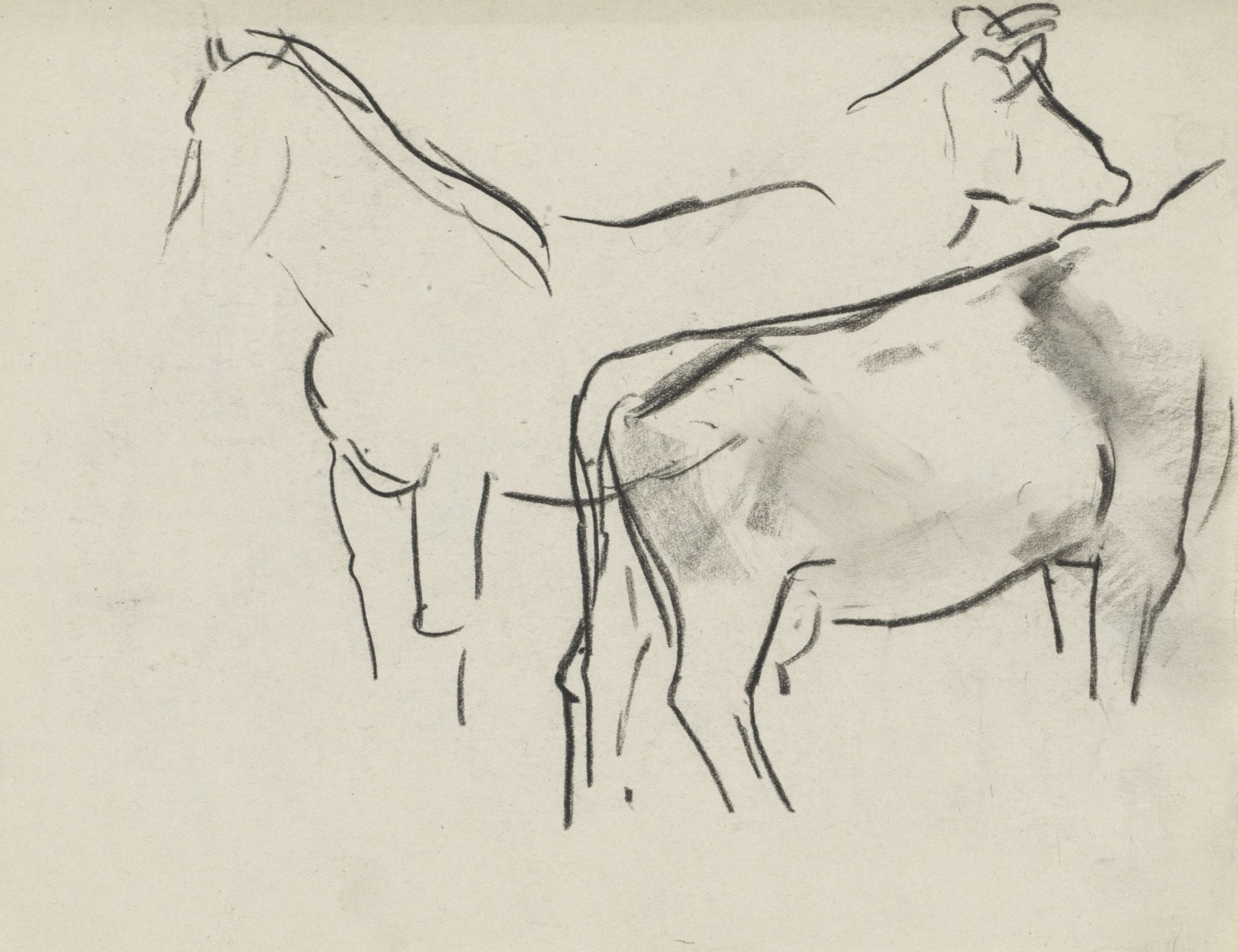
I have read about an adventurous moose who travelled, slowly, across the lands known to our complicated human minds as Romania, Czechia, Slovakia, and Poland. Upon visiting my homeland, he then went on wandering, freely, unaware of the abstractions that most of us, two-legged animal wanderers, are subjected to. These would demand that we stop our journeying at the so-called border, necessitating drawing another abstraction of an ID or a passport to prove the greatest abstraction of them all: identity.
As for the moose, he was recognised, rightfully so, by virtue of his undeniable moose qualities, and so he went on. As he crossed the lands known to his simpler, more grounded mind, as lands underneath his hooves, carried by the long legs that took him where he pleased, the large, magnificent head poised with utmost finesse atop his muscular torso, and the leaf-shaped ears attuned to the forest, there was no room for doubt about his right to belong to this world and be welcomed in it. And so the moose was free of doubt as well.
He slept when it was time for sleeping, the article read, and he fed on the expansive sun-soaked pastures or pleasantly cool, tucked-away forest meadows when the vastness of his belly made it so. In my mind’s eye, I envisioned him resting softly on the mossy bed in someplace that knew itself to be a place experiencing no need for a name or sign to prove its existence.
As my eyes moved, following the tracks of the moose’s heavy hooves across the fragile alphabetic trails on the page, each of them bursting with effort to (rather poorly) do justice to the gravity of his wondrous existence, I began sensing a thunderforce of a longing surging from the belly, gathering through the chest, grasping at the throat as if trying to make me, too, doubt-free: if you don’t listen to me, I will claim your breath.
Oh, how I wish to be like this moose, I thought with tenderness. How I long for a wilder and less mediated life, one somehow felt viscerally still as an inheritance from my early ancestors. Or, as Mary Oliver longed for too, I wish “I owned nothing, like the grass.”
I dwelled recently in a time and place that felt as if the world had forgotten about it and had not yet managed to spoil any of it with its constant wanting and striving for profit.
Swathes of uninhabited land stretching all the way to the horizon (which is an increasingly rare sight in this densely populated part of the world), thick and boundless forests, quick creeks and solemn rivers bejewelled with boulders and fallen trees. And the heart, unadorned, hungered, plunged right in the middle—remembering at last what it was made for.
Locals are few, and the connections are strong: people know their neighbours by name and exchange skills and services to support each other—an uncomplicated expression of goodwill and interdependence that, in the rush of the fast-paced world, increasingly escapes us.
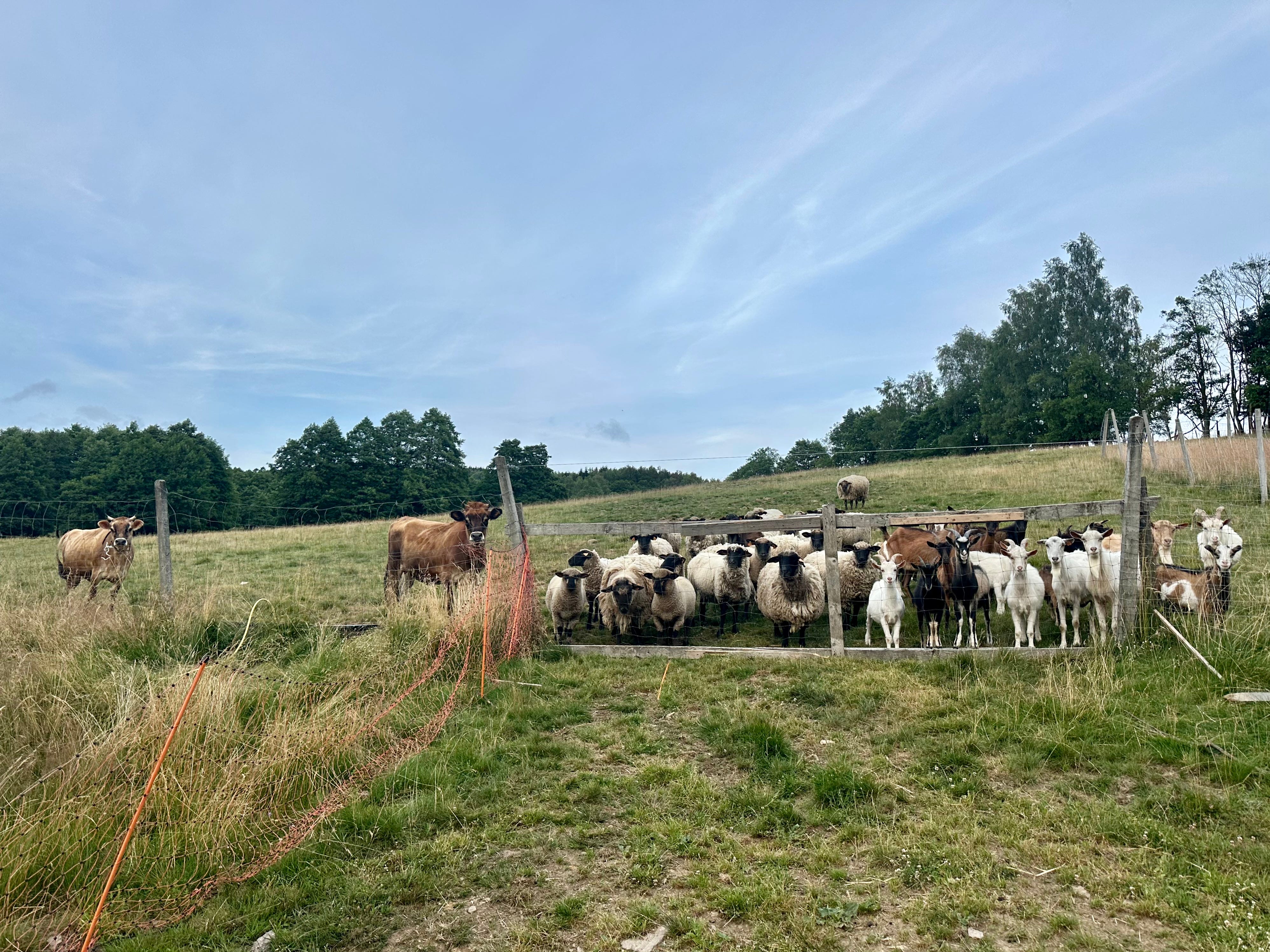
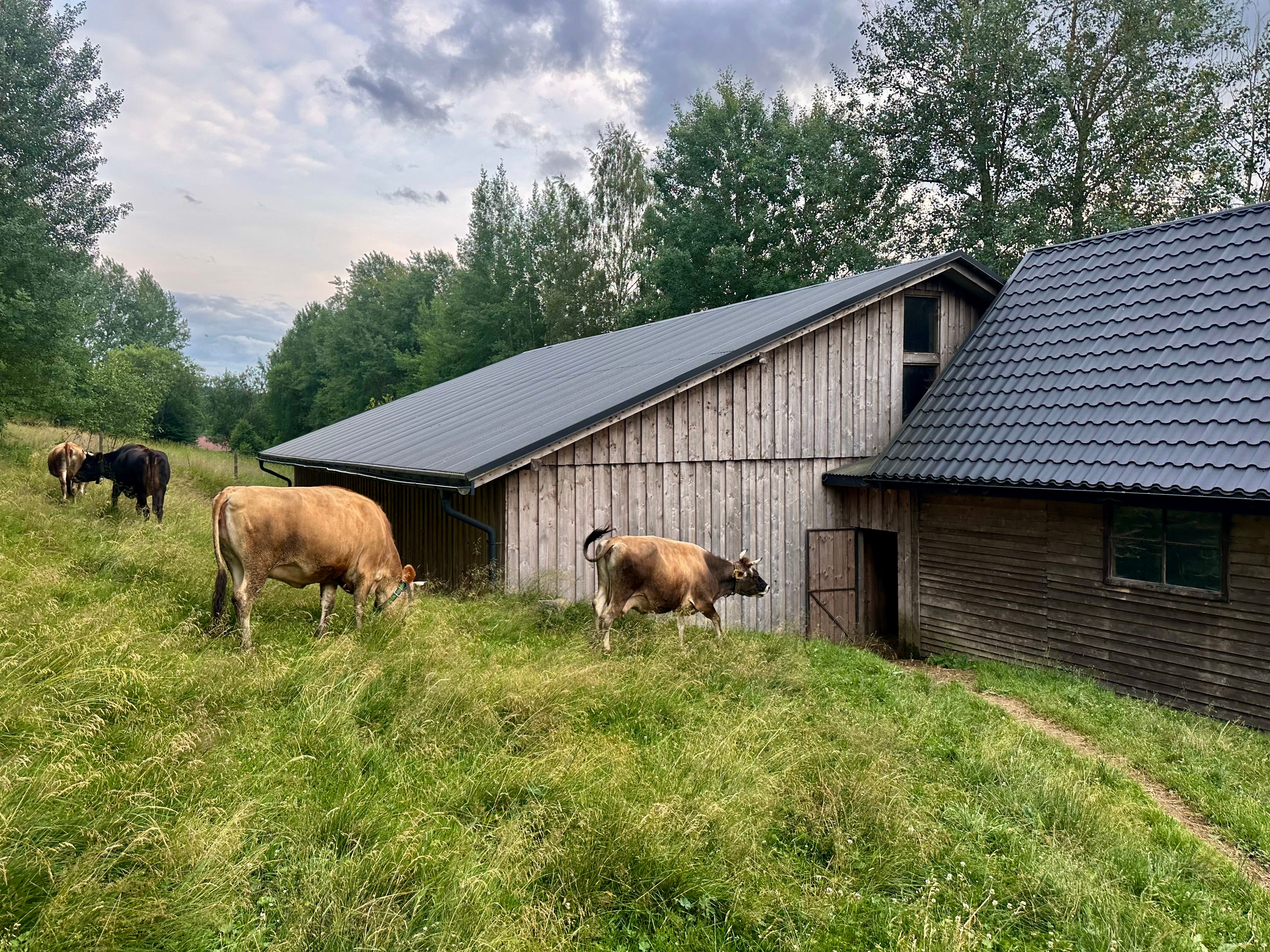
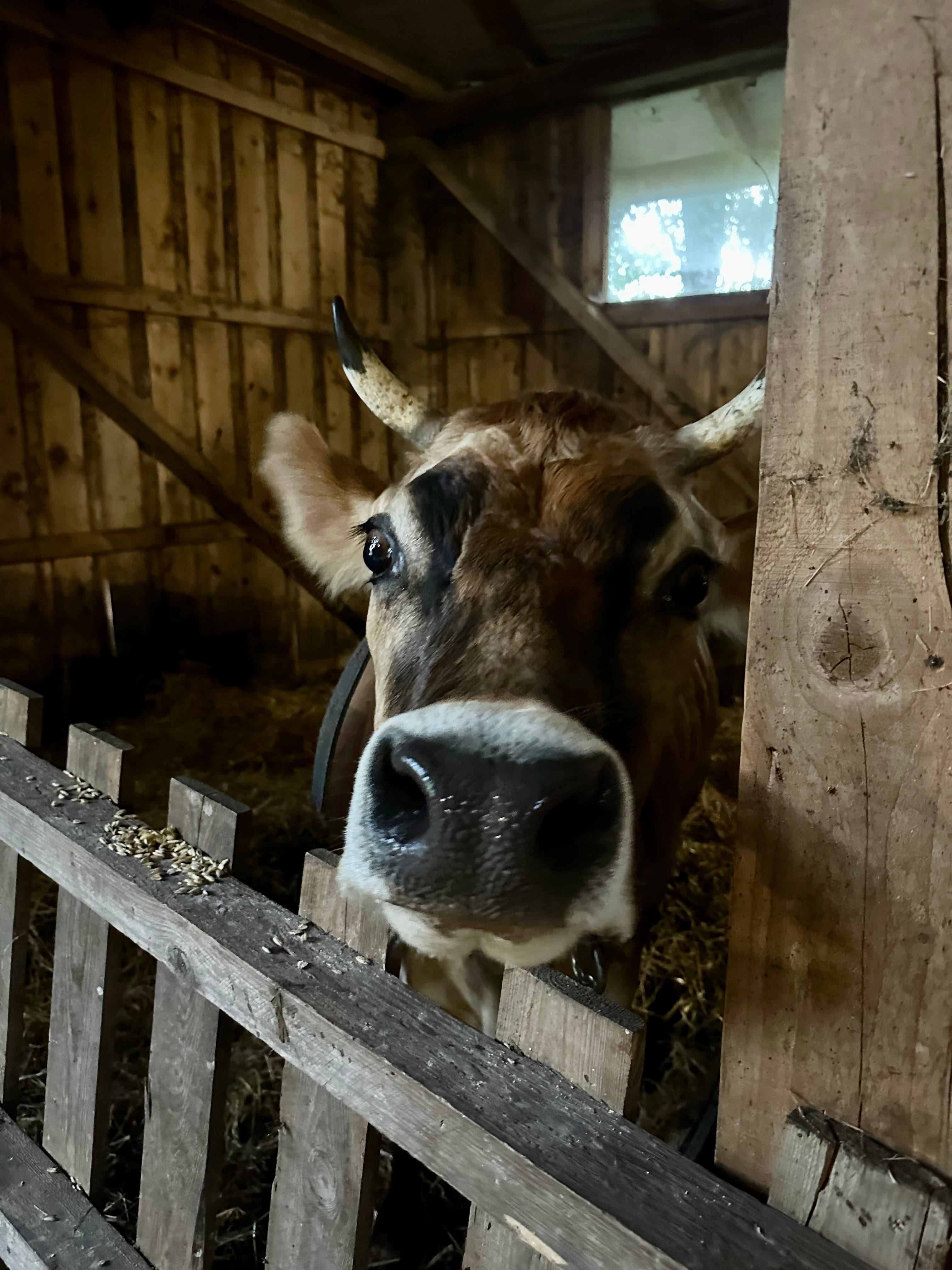
The cows’ names are known, too. And the ones I had the pleasure of meeting are, in no particular order: Mary, Ola, Hannah, Chloe.
I hope you will not, dear reader, take what I am about to say as a sensationalist exaggeration, but I must admit, quite truthfully, that they were among the most beautiful and dignified ladies I had ever met.
Mary, the largest of them all, with quick and piercing eyes, seems unapproachable when out in the pasture. She charges ahead and swings her head full of wondrous thoughts in a kind of movement whose meaning can only be understood as follows: the life and the cow are one; each is possessed by the other; watching the cow dancing in the fields, we are, in fact, witnessing the play of the universe itself. But as soon as Mary’s opulent body is enclosed by the walls of the modest barn, which seem abashed to be housing her exuberant presence, she seamlessly adopts a fitting demeanour, now generously accepting visitors, welcoming ear scratches and forehead rubs most of all.
Ola, dark-coated, is a different matter—she carries a slow, unhurried grandeur that suits her reserve. One might misread her as shy, as I first did. Only on closer acquaintance did I come to see her more fully: self-possessed, inward-looking, and settled. She typically avoids scratches, accepting only a few, if any—and sparingly. This welcoming or lack thereof is always preceded by careful, slow consideration—enacted through her soul-reaching gaze and tentative hand-sniffing, her nose moist and soft, mostly withheld, as I mentioned, from grasping, longing, unslaked touch. The human hand, parched with wanting; Ola unbothered, complete in herself.
Hannah, the smallest of all, is lively with the unapologetic force of youth: restless, impatient, delighting in quick, bucking runs. She appears to me submerged still in the process of developing the many inner layers that gradually and inevitably form the fascinating and mysterious cow personality. Learning through doing, she already is a teacher, and I welcomed her lessons humbly and with gratitude. Once she finds herself in her personal corner of the barn, she, too, quietens a notch, and seems glad to receive cuddles and strokes on her ever-wise big head.
Chloe, the mother of these three, is slow and steady both out in the pasture and back in the barn, though she strikes me as anything but unimaginative. I will go ahead and wager that her innermost life is as wild and untethered as the fields and forests she traverses daily. She keeps to her ways and observes, undoubtedly forming fascinating conclusions I so wish to be let in on, even a little. She deliberately sniffed my hand as I offered it, knowing full well that this, already, was a great act of generosity and grace. She then politely signalled “no thank you” as I extended my hand for the stroking, and she withdrew to her default stance of calm, all-knowing observation.
There they were, the great teachers of living this life fully and directly, and I—their reverent disciple.
More and more, my feet depart from the nuclear arrangement of living and relating that many of us have been framed within, and which, not so long ago, still seemed to me the only one possible. I am led, as it seems, into greater, deeper connection. A way of life demanding careful attention, rooted openness, a kind and generous heart, dutiful responsibility, and a great deal of humbleness.
Exploring new, yet age-old ways of living and relating—to each other, and to this world. Embodying the teachings I received from Mary, Ola, Hannah, and Chloe. Learning when to act with conviction and when to withdraw steadily with grace. Studying the ways of communal living, wise contribution, reciprocal coexisting with the animal and plant relatives, and the land we all share; offering time, skills, and kindness as service for the benefit of the whole. Opening up to the world with each breath, letting it touch me directly. Letting go of limiting defences. Honing a heart that can be touched deeply and still, even when challenged, respond with compassion and kindness. Practising moving slowly, in a trusting, patient relationship with reality, rather than fearfully controlling it. Asking many, many questions—and not rushing any of the answers.
“I am certain this is the way,” I told my friend the other day in a sixteen-minute-long voice note. We were exchanging our hopes, fears, and joys as she, too, commits more fully to a way of living pointed to by many spiritual teachings, including the Tao: “in dwelling, live close to the ground.” I had to stop recording mid-sentence. I was so caught off guard by the words I had voiced as they sifted down onto the table where I sat, like the dust shaken from a bird’s feathers, the bird already gone. I did not expect the decision to form on its own like that, subterranean.
“Yes… I am certain this is the way,” I repeated a few times to myself, carefully tasting these words on my tongue, trying them on against the heart which swelled up and gathered as it received them one by one. The greatest truths often find us unprepared, at the kitchen table. Fittingly, they appear at first as mere crumbs. There is a promise of nourishment. But the meal, the whole, is ours to envision, discover—tracing, crumb by crumb, the great mystery of life itself.
I know little these days. So I follow whatever offers even a sliver of reassurance and clarity amidst all the fogginess. Where, directed by intention, I can breathe in fresh air—that is where I apply myself. Currently, the effort is therefore in cultivating the clarity of enoughness. Stripping away the distractions of excess and superfluous comforts.
I am lessening my belongings to increase the felt universal belongingness, unmediated by material goods. I plan to fit them all into a backpack. Careful consideration is necessary to understand what should earn its place within this narrowed-down space, and what should be released and re-homed with gratitude for the service it provided me.
As days and weeks pass, I slowly sort through, organise, sell, and give away the majority of what I own. It is a joyful process, and one in which I trust. With this steadied effort and growing spaciousness, more clarity naturally forms, informing next steps. It is a kindness offered not only to myself, but also to the natural world, and to others—having and needing less, I also require fewer resources, both natural and financial.
Naturally, with the decrease of possessions that were made responsible for offering me comfort or ease of functioning, I am tapping more into the renewable resources I always carry with me: creativity, critical thinking, problem-solving, collaboration, boundary-setting, asking for help and receiving it without shame. I also cultivate other skills that might come in handy as a means of exchange: cooking, knitting, sewing, drying herbs for teas and medicine, drawing, gardening, caring for the animals, and offering meditation and writing gatherings. All of it is the wealth I am currently building, and which I am learning to share wisely and in a balanced manner.
Another large field of exploration and careful experimentation is health. Participating in this world through a body that experiences several chronic illnesses continues to teach me invaluable lessons, but it also imposes limitations and challenges. I am therefore slowly testing where my current limits are, gently moving and expanding them to accommodate greater flexibility and resilience. I am also seeing doctors, paying more careful attention to nutrition, and incorporating exercise whenever possible.
Finally, though by no means lastly, I train my heart and body in fearlessness. It is a slow, multi-layered process and one that should not be forced, as it may wound the heart and destabilise the mind. It is simply a practice of increasing exposure to sights, experiences, and ways of living that evoke in me a sense of fear, while observing their effects on the mind and heart, and each time gently returning to the centre.
I am currently helping take care of my mum’s farm during her travels, as she flew to the United States to meet her first grandchild—my brother’s son. Among the animals and their many hungry mouths, are four horses. Beautiful and dangerous creatures. One of them, who is now over twenty-five years old, has been with us since I was a child.
When I was ten or eleven, I was cleaning his legs following my father’s strict instruction. The horse kept pulling his leg out of my hand, with increasing force. I was afraid he would eventually kick me, but my father did not want to hear about fear. “You cannot show the horse you are afraid,” he rebuked me, and as I made one more attempt to clean the hoof, it shot up, straight into my head. I lost consciousness, and the next thing I dimly recall was the rushed drive to the hospital and the two following weeks spent there.
I had a concussion and was close to losing my left eye. The heart and mind were wounded, too. And they encoded this experience as life-threatening, causing me to relive it ever since through debilitating panic attacks that froze my body in place each time I was around horses.
I made many attempts at dissolving this fear over the years, including moonlit galloping through the humid forests near Samaná in the Dominican Republic. After many controlled and kind exposures, I am doing much better now. But still, especially around this particular horse, my body sometimes freezes. So I make it a practice to spend time around the horses some days. I approach him to stroke his neck, or to feed him, and I observe the effects of it on my heart and mind.
This is just one of the many more or less demanding exposures I undertake, with each breath training myself in returning to the centre—to the unconditioned at the root of the heart, remembering the teachings and experiences of selflessness and unity with all.
So, how does one walk a foggy path? That is to be explored. And that is probably what you will read more about here, on Stacking Stones, in the upcoming letters. I will continue to stack stones for you, and myself, with each of these letters, forming cairns as signposts on the unfolding trails of our inner lands.
Grateful, humbled, and reverent for the fact of your two eyes, two feet, and one loving heart, dear reader, accompanying me on this path, helping each other find ways back home—to the heart.
If you wish to support the work that goes into writing these letters, becoming a paid subscriber is a great way to do so.
To stay with this a while longer, spend some time with Mary Oliver's prose poem beginning "I own a house, small but comfortable," from her collection Swan. It has nourished my heart, and may yet nourish yours.

Dearest reader, thank you for walking this path with me. For stacking stones alongside it, so we can all find our ways back home.
This space is supported by you
These letters are a labour of love but also time and effort. If you find value, support, inspiration, or comfort in them, help me continue this work by becoming a deeply valued patron. It’s only $6,9/month when you sign up for the year.
Alternatively, tapping the heart button, leaving a comment, or sharing this piece with your community will make it easier for other people to find this publication.
Thank you for contributing to this practice of offering through writing 🙏

Before you go
This week’s reflection:
What can you release of all that you think belongs to you, so that you might belong more truthfully to the world?

With you on the path,