
Hello,
How are you this week? Did you let yourself get your shoes wet and muddy?

This is Part Two of the new, two-week series From the Archive (April 2025), revised, enriched with new stories, and this time narrated. You can choose to read or listen—or do both!
If you’d like to begin with Part One, here it is.
I went for a walk through the forest, which is what I’ve been doing every day. The early days of November are graciously sunny, and I try to soak it all up.
Partway up the hill, I stumbled upon two shacks. Their shape resembled a teepee, and they were built with a gathering of sticks alone.
As I approached them, a long-forgotten thrill of adventurous play jolted through my body. For a second, my imagination rushed ahead and, with eagerness, inhabited this wooden home of endless possibilities. As soon as it arose in me, however, it was already gone. I miss that feeling, I thought.
I kept on walking, noticing with a smile that the paths trampled by my and the dog’s feet were now becoming visible across the thick carpet of the fallen leaves.
These were the same paths, I realised, which were traced by my five or six-year-old feet, chasing my older siblings and cousins. We used to call this a warrior’s trail, and sometimes my older brothers would make me run all of it before I could get lunch. Growing up as the youngest comes with its own trials.
At the end of the trail, we built a shack of our own. We’d collect sticks and pull out the ivy from the soil to tie the construction together. We made windows with leafy curtains and dug steps in the side of the ravine. Then, we brought in kitchen appliances and a chair and an old TV frame and we called it a home. It didn’t take much to feel at home back then.
I used to know the forest the way one may know the constellation of moles on their face, the texture of the skin on their fingers, or that one unruly eyebrow demanding combing every morning (well, at least mine does).
Now I know it too, but mostly just conceptually. I am informed, as we all are, that it is good for me to go spend time among the trees, and I certainly feel the benefits of it. But the problem is, I learned to go there with a request; I ask the forest to give me something I want: a sense of peace, a release from stress, spaciousness, tranquillity, inspiration.
Back when the body was smaller still and the imagination not yet trimmed to fit its inherently narrow parameter, stepping in between the trees used to be a way of co-being with the forest, co-creating with it in a delightful state of play.
One would go with openness to the possibility. It was never known whether the forest will become a building site for a new home, a training ground for races, or a scientific lab in which to investigate the ever-mysterious nature of a frog by the stream, or the complexities of bug lives occurring quietly in the chambers of the leaf litter.
Entering the forest with empty hands and without expectation allowed it to offer back what it wanted—not what I asked of it. There were no demands placed on the trees and their natural properties. Each corner, each tree, each patch of moss was a treasure cast of possibility, enlivened by the child’s imagination—and because of that, the forest and I were equals. Neither was confined to the role assigned to them by the world.
I wanted to feel it again—that sense of wonder and play. So I squatted down as my dog ran around me in widening circles in the search for a perfect stick. I began awkwardly playing with pine cones scattered around. Lacking better ideas, I arranged them in a pattern of lines.
What began as an intention of play resulted in yet another attempt to control the world around me, to make it neater and in some way explainable. With sadness, I realised I do not know anymore what to do with the pine cones. They no longer tell me their secrets, which were so readily accessible to a child’s hands.
A little disheartened, I pressed my adult hands to the moist forest floor to feel the Earth, observing between my fingers the white web of fungi peeking out from under the dried, decomposing leaves. At least I know how to do that. At least this.
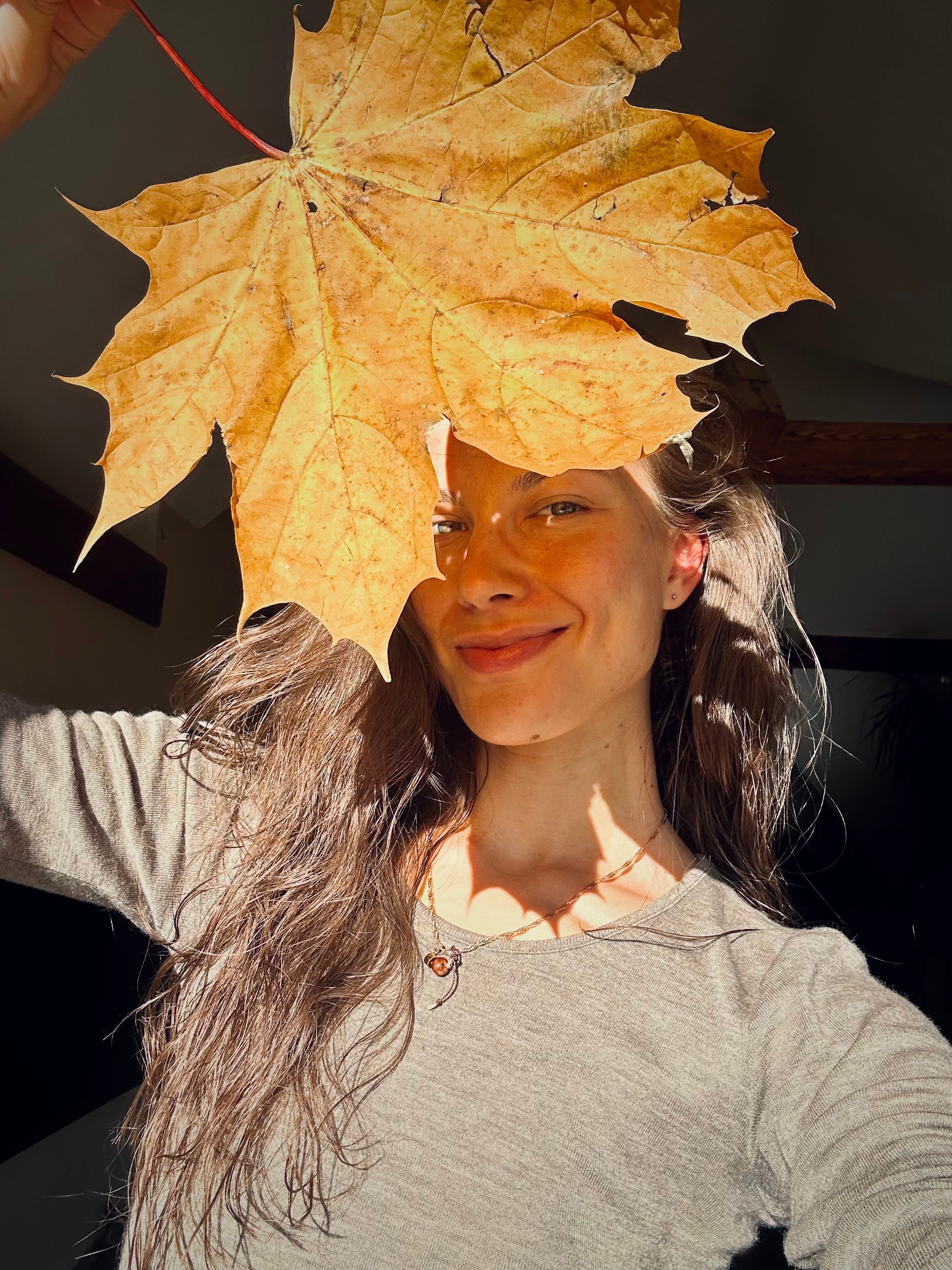
Nearing the end of the walk, my attention was drawn to a wonderfully big and bright yellow leaf resting against the tree’s root.
“I want that leaf”, I suddenly felt. It was such a fine one; everyone would want to have a leaf like that. Immediately, though, the judgment came: Why would you take it? What for? You don’t need that leaf, there’s no use for it. Besides, there’s mud on the way and your shoes will get wet.
I was about to walk away leafless. But no, I decided. I will not give in to this nonsense anymore. I will step off the path, I will risk getting my shoes all wet and muddy, and I will take that leaf purely for the sake of holding it in my hand and delighting in its excellent shape and size and the gorgeous shade of yellow.
On my way back to write this, I was swirling that leaf in my hand—for, you must know, besides being delightfully large and yellow, it also was equipped with a fantastically long stem, perfect for swirling.
It seems to me that, as awkward and clumsy as it is, I began collecting and reintegrating the traces of my childhood scattered across the forest floor, hung up in between the trees like the barely visible threads of spiderwebs, which I unknowingly carry home woven between my hair. And through it, I feel myself getting closer to the sweet emptiness of being.
For as it was written, “Unless you turn and become like little children, you will never enter the kingdom of heaven.” Matthew 18:3.
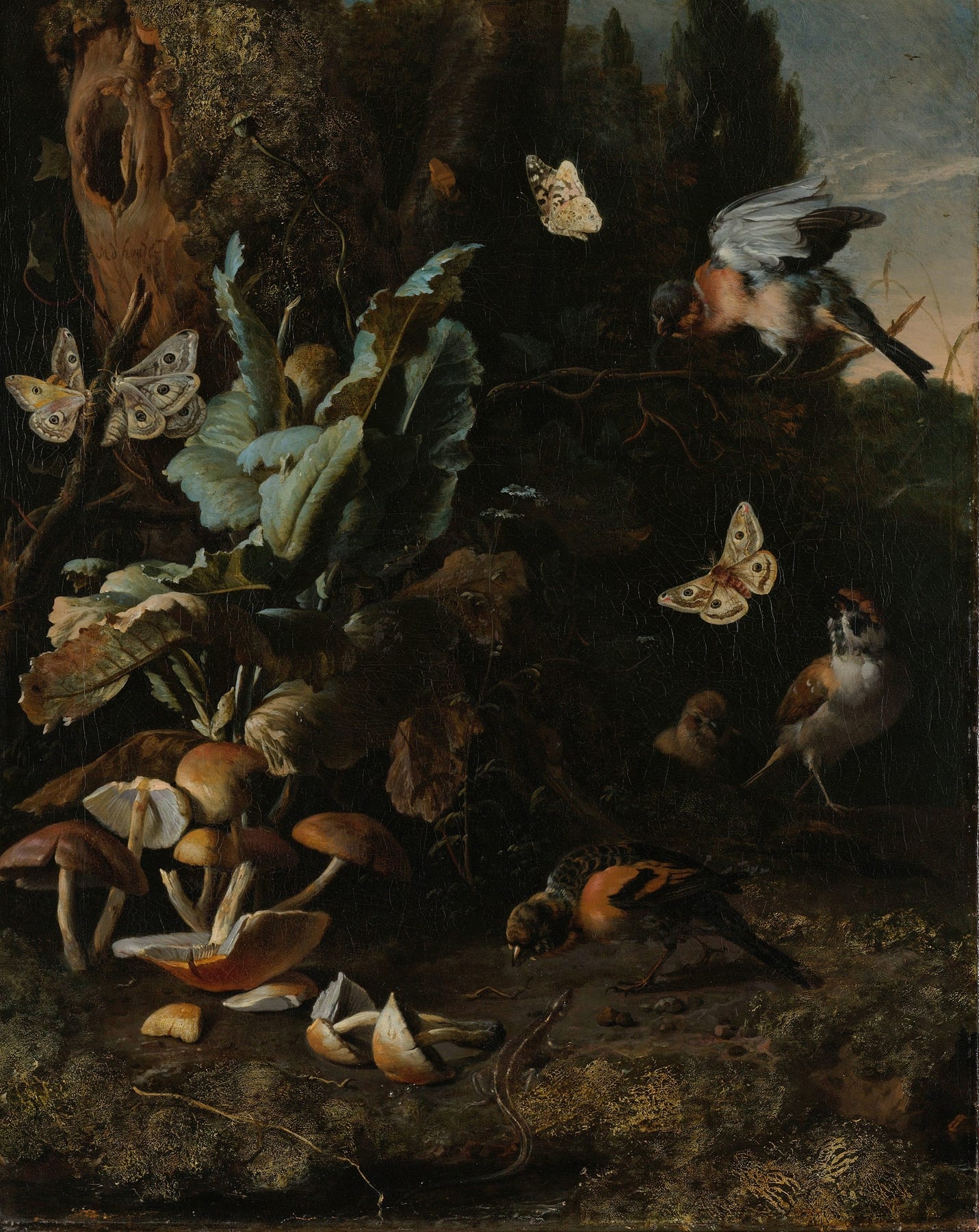
Another day, I found a butterfly on the windowsill in the garden shed, where new plants—tomatoes, peppers, aubergines, strawberries—were silently stirring towards wakefulness from their seed-stage dormancy; all nestled in small pots which held them in soil before, once more, they were held directly by the Earth herself.
The butterfly, Paź Królowej, was, however, at the other edge of the cycle, having already slipped into eternal dormancy. It must have remembered the flight of last summer. Now, its wings were furled inward, protecting its body’s dream. I looked carefully at its tiny, still face; the limbs once eagerly steeped in pollen now curled up, frozen in the air like a thought too big or scary to pass through the narrow corridors of one’s reckoning.
I welcomed the body into the palms of mine, which formed a soft shelter—one cupped gently over the other, with just enough space for a breeze to caress the motionless wings.
I held it nestled in my palms as I rounded up the hens and geese and ducks into the coop for the night. With my hands entirely devoted to the butterfly, I was unable to keep them stretched to the sides as a boundary between the day and night, so I had to walk more, cutting off the pathways of the quick and small bird feet stubbornly running back towards the pond, unwilling to reconcile with the day’s departure.
I brought the butterfly home and placed it on my shrine, next to the feathers. Gifts. Gifts in abundance; reminders that beauty and grief are not opposite poles but part of the same truth-field.
The complication in our unbecoming-to-return is that life comes with no trigger warning. Things happen out of the blue. Something unfolds, and suddenly, with no preparation, we find ourselves in the middle of a happening we did not wish to partake in.
A few days ago, I was driving a car, and my eyes settled on a small black-furred body thrown in the middle of the street. Someone’s best friend, perhaps: a two-loving-hands-sized, pointy-eared dog, had made its last walk that day. I felt a wave of grief wash over me. I, too, share my life with a two-loving-hands-sized, pointy-eared dog.
I wanted to stop my car, get out, and lift the little body discarded by the world from the harsh asphalt, and lay it on the soft grass somewhere nearby but away from the death-bearing car wheels. But the street was too busy for me to do it safely. Driving away, I sent love to those paws that had carried this entire cosmos of a little furred being through our lucky world—and which now lay frozen in the air, just like the limbs of a butterfly.
I think that is why “here” is really important when you are in a situation for which nothing has prepared you—that is the space for honest inner reckoning. For disillusionment. “To have the language of ‘here,’ it is not gentle. It’s not even consoling. It just might be part of the truth. And that can be healing, to simply tell part of the truth,” offered Pádraig Ó Tuama in his conversation with Krista Tippett for On Being.
And so the part of the truth I have told myself today is that I did not know what to do with the pine cones. And then, more courageously, that I did want that large yellow leaf. I had to un-self right there, where and as I was standing, for this voice carrying bits of truth to come through. Part truth by part truth, we arrive ever closer to the ultimate truth of being.
We might not know what awaits us on the path, what we will stumble upon as our feet carry us across the beaten tracks, and especially nothing can prepare us for those moments when we choose to step off the track—and venture into the unknown. Perhaps then, what is asked of us, is to remember to tread with openness to possibility, to reignite the bygone wonder which expected nothing but delight with each step, around each corner.
, the facilitator of the Meditation Teacher Training course I am now attending, reminds us over and over again, “Prepare to be delighted every day”. It is something we knew without fail as children, just like one may know the texture of the skin on their fingers. Just like I used to know the forest. I am sure the pine cones can whisper their secrets to our adult fingers still. But in order to hear them, we must step out of our narrow selves into the ever-awaiting opportunity of delight.You may be thinking that in writing this all, I am going in circles. I say—it is a spiral. With each round, something is let go of, left to disintegrate amidst the fallen leaves, lightening my step along the trampled path. More often now, I am daring to step away from that beaten track. I let myself explore, re-opening to the wonder.
“We are not meant to become someone else. We are meant to excavate the original knowing we came with,” wrote Toko-pa Turner. It is a slow process, and there are many layers still. But I’d rather be peeling them any day, than accept that I no longer know what to do with the pine cones.

If you find warmth, comfort, inspiration, joy, motivation, or anything else of value in these letters and would like to show your support, please consider becoming a deeply valued patron by upgrading to a monthly or yearly subscription. This will also give you access to the special, paid-only letters. If you have a financial restriction, please don’t hesitate to contact me.
Come take a look at the perfect swirling!

Before you go
A question to aid you in this week’s reflection:
What is one thing you can do this week to reignite the child-like sense of wonder and play?